
If you have ever debugged regular software before, you have a set of habits that do not fully transfer to agents. When traditional software fails, it leaves a trail.
The inputs are bounded, and the same input gives you the same output every time. And when something throws an error, you get a stack trace pointing at the line where it happened.
Agents are different, in 3 ways
FIRST, the inputs are unbounded.
Users type whatever they want, however they want to phrase it, so there is no fixed set of inputs you can plan for ahead of time.
SECOND, the outputs vary.
The model samples its answers probabilistically, so the same question can give you a different answer the next time you prompt it.
THIRD, you cannot see the reasoning.
A single reply to a customer might involve a dozen model and tool calls underneath. The agent chose those tools, chose the order to call them in, and decided what to do with each result. None of that shows up in the reply.
Put those together, and you get a real problem. If a customer tells you the agent got their order wrong, all you have is a paragraph of text. You do not know which step went wrong, or whether any single step went wrong at all.
It also works in the other direction. An agent can produce a perfectly reasonable answer while doing something wrong along the way. So a good output is not proof that the agent behaved well. Either way, you need to see more than the output.
The natural reaction to all of this uncertainty is to test more thoroughly before you launch. That helps, but it cannot be the whole answer, because you cannot test every possible input when there is an unlimited number of them. So, instead of trying to catch everything upfront, LangChain uses a process that continuously improves the agent even after it is live.
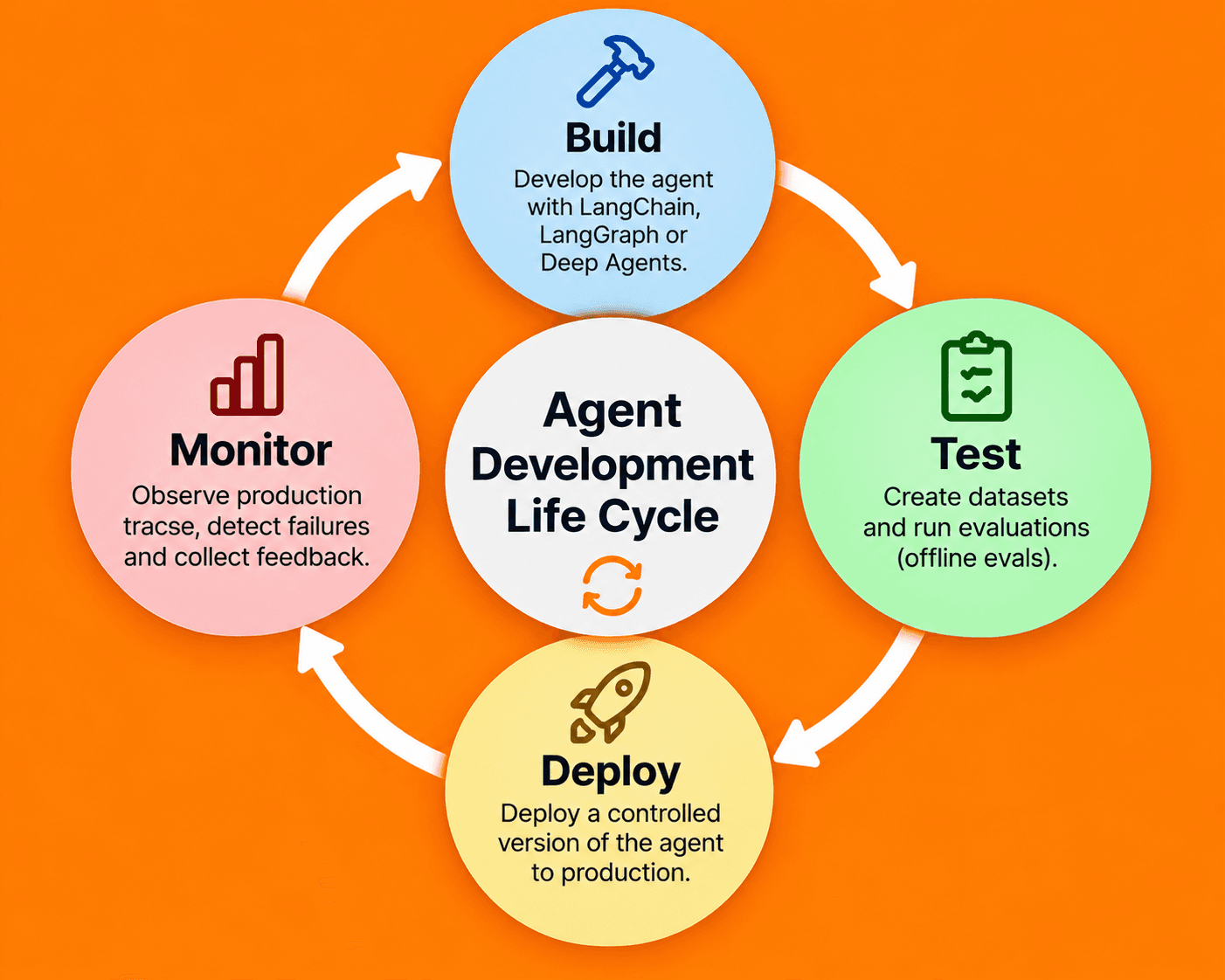
It is called the Agent Development Lifecycle — ADLC — and it proceeds in 4 steps:
BUILD is where you shape the prompts, the tools, and the logic.
You turn tracing on from your very first run, so you can see what the agent is doing from the time you start development.
TEST is where you move from “it seems to work” to concrete evidence.
This stage is done with datasets, evaluators and experiments that score the behavior of the agent before and after a change.
DEPLOY is where you put the agent in front of real traffic, with tracing still turned on.
MONITOR is where you watch what the agent does with that traffic, using online evaluators & dashboards, and then turn the failures you find into new tests & fixes.
This last stage is what makes this a “loop” rather than a “checklist”.
When something fails in production, you turn it into a dataset example and an evaluator, then fix it. The next time around, that failure is covered.
LangSmith is the platform this loop runs on.